

How ShowOps Works
ShowOps engagements are deliberately simple in structure and disciplined in execution.
The purpose is clarity — not volume.
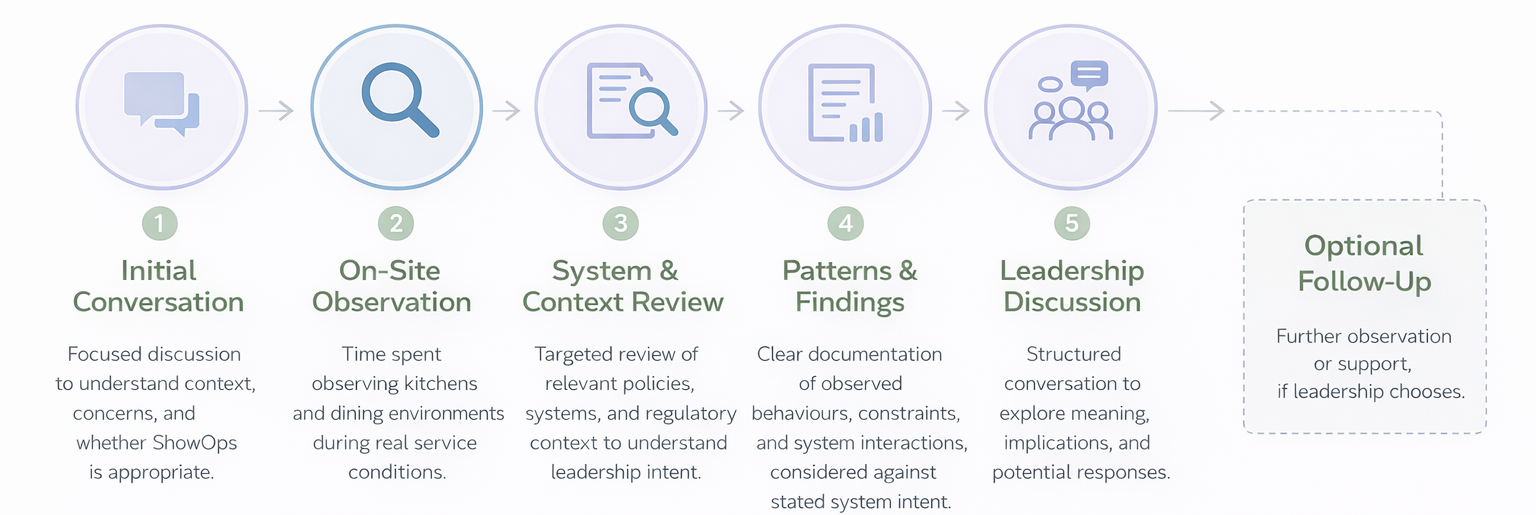
1. Initial Conversation
A focused discussion to understand context, leadership concerns, and whether observational work is appropriate.
There is no requirement to prepare a formal brief or define a problem in advance.
The objective is to clarify scope, expectations, and practical arrangements.
2. On-Site Observation During Live Service
Observation occurs inside kitchens and dining environments during live service.
Work is observed as it unfolds under normal operating pressure — across timing shifts, staffing variation, and environmental constraints.
The focus is not on isolated incidents, but on recurring patterns:
How work is sequenced
Where pressure concentrates
How systems are applied when conditions change
Where informal adaptations influence outcomes
Observation is conducted without interrupting workflow.
3. Post-Observation Context Review
After on-site observation is complete, relevant policies, procedures, and recent regulatory findings may be reviewed.
This sequencing is deliberate.
Observation occurs first, without reference to documented intent.
Context is reviewed afterward to understand alignment, drift, or contradiction between stated systems and lived practice.
This is not a compliance assessment.
It is a structured comparison to support sense-making.
4. Pattern Identification and Report Preparation
Observations are consolidated into recurring patterns.
The report documents:
What was directly observed
Where operations align with intent
Where strain or drift is emerging
What the observed patterns indicate about system resilience
The distinction between direct observation and interpretation is maintained throughout.
5. Leadership Discussion
A structured conversation to explore meaning, implications, and potential responses.
The purpose is not to prescribe solutions, but to ensure leadership has a clear and shared understanding of operational reality.
From that position, decisions can be made deliberately.
Optional Follow-Up
Further observation or engagement may occur if leadership determines it is necessary.
Any expansion of scope remains entirely at the organisation’s discretion.